

How to Start an E-commerce Business in India: A Complete Beginner’s Guide
Starting an online business in India has become far more accessible than it was a few years ago. You no longer need a large showroom, expensive office, or massive inventory to begin selling products. With the right idea, a reliable supplier, a simple e-commerce website, and a practical marketing strategy, even a small business can reach customers across the country.
However, launching an online store is about much more than putting products on a website. You need to decide which e-commerce business model suits you, identify a profitable niche, understand your target market, manage product sourcing, calculate e-commerce startup costs, choose suitable payment and shipping solutions, and build a system that can handle orders and customer service.
Whether you are interested in building a Direct-to-consumer (D2C) brand, selling through an online marketplace, starting a low-cost e-commerce business, or experimenting with dropshipping, the fundamentals remain similar.
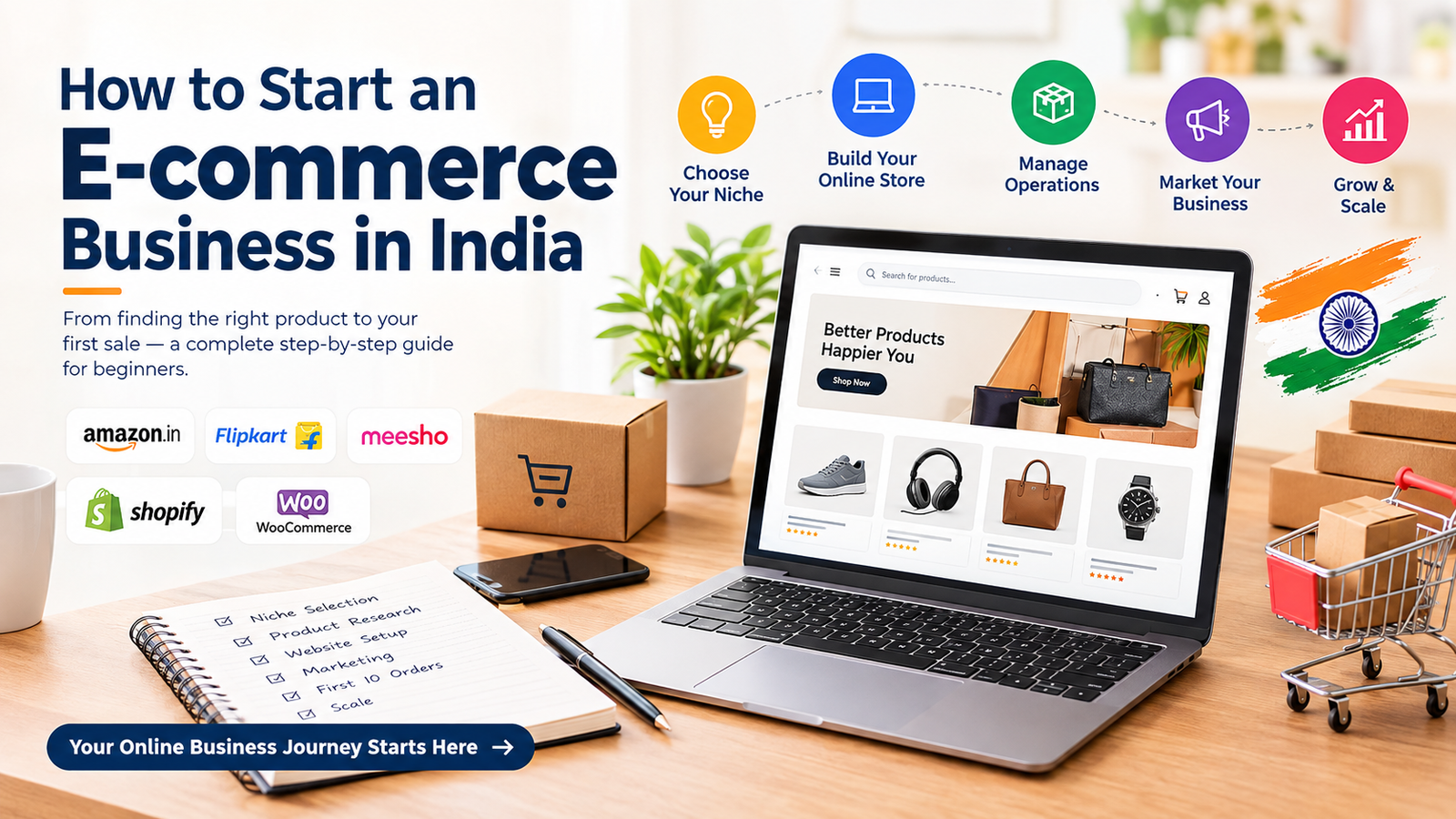
This guide explains how to start an e-commerce business in India step by step, from choosing your first product to getting your first 10 orders and eventually scaling your store.
1. Choose Your E-commerce Business Model and Find the Right Product
The first decision is not which website platform you will use. It is deciding what you will sell, who you will sell it to, and how you will make money.
Start with niche selection and product research
Good niche selection gives your business a clear direction. Instead of trying to sell everything to everyone, focus on a particular customer group and solve a specific problem.
For example, instead of creating a general fashion store, you might focus on men’s casual wear, affordable women’s ethnic clothing, fitness accessories, or sustainable home products.
Your product research should answer questions such as:
- Are people already searching for this product?
- Who are the existing competitors?
- What price are customers willing to pay?
- Can you make a reasonable profit after shipping, returns, advertising, and taxes?
- Is the product easy to store and ship?
- Does it have potential for repeat purchases?
- Can you differentiate your brand?
This process helps you work toward product-market fit—the point where your product meets a genuine customer need and people are willing to buy it.
Understand different e-commerce business models
There is no single model that works for everyone.
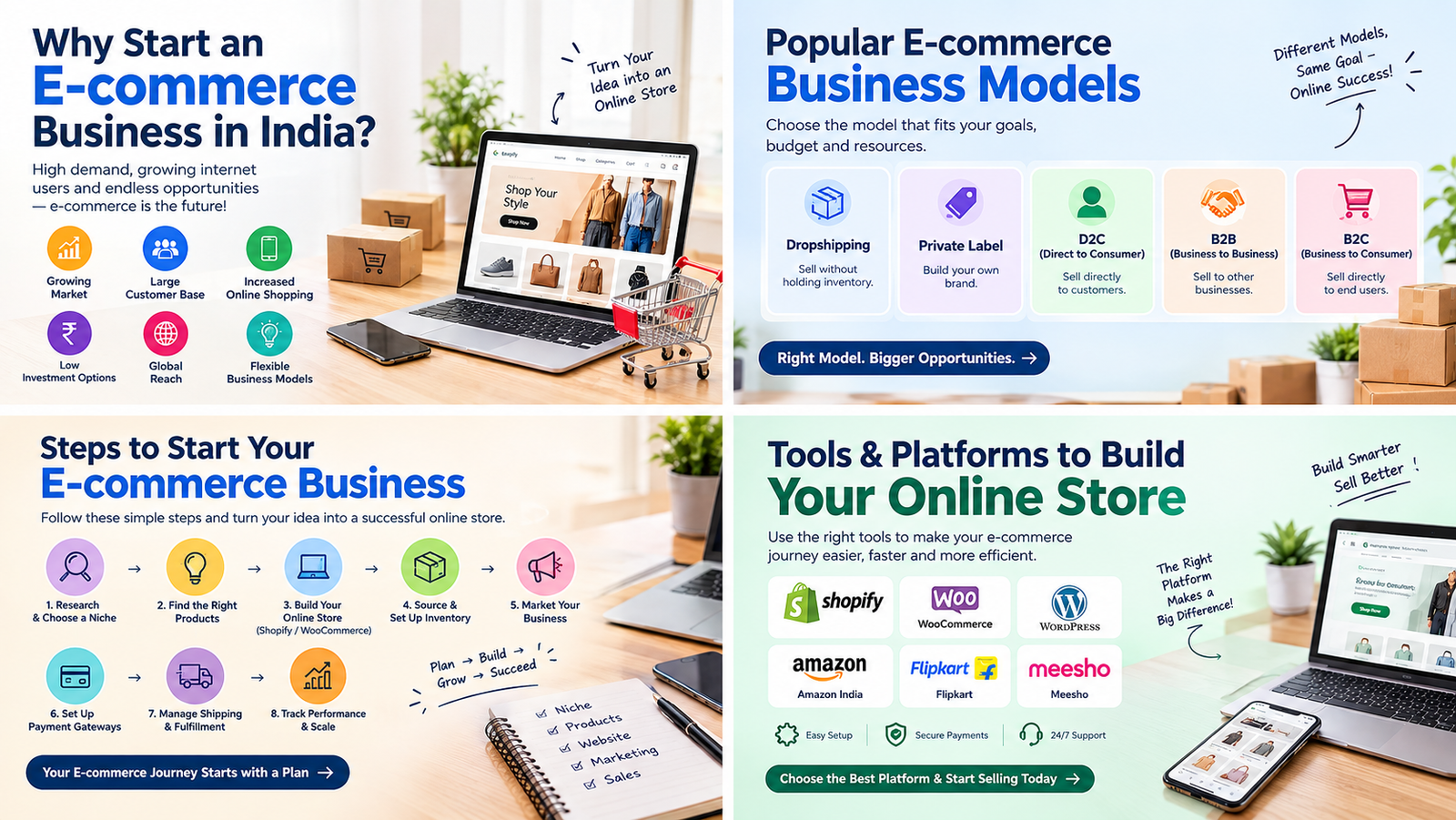
A business-to-consumer (B2C) model sells directly to individual customers. Fashion, beauty, electronics accessories, home décor, and personal-care products are common B2C categories.
A business-to-business (B2B) model sells products or services to other businesses. Examples include wholesale supplies, office products, packaging materials, and commercial equipment.
For consumer brands, Direct-to-consumer (D2C) is particularly attractive because the business controls its website, branding, customer relationship, and marketing rather than relying entirely on a marketplace.
Another option is dropshipping, where you don’t hold traditional inventory yourself. When a customer places an order, the supplier fulfills it. This can reduce upfront investment, but you have less control over inventory, product quality, and delivery.
If you want to create your own branded product, private label allows you to sell products manufactured by another company under your own brand. White label is similar, but the same or substantially similar product may be sold under different brands.
You can also explore print-on-demand, particularly for products such as customized T-shirts, mugs, posters, notebooks, and accessories.
These models can make e-commerce without inventory possible in certain situations, but they don’t eliminate business risks. You still need to consider quality, customer service, shipping, refunds, and marketing.
Conduct competitor analysis before investing
Before buying stock, conduct a proper competitor analysis.
Look at established websites and marketplaces such as Amazon India, Flipkart, and Meesho. Study:
- Product pricing
- Product titles
- Product descriptions
- Product photography
- Customer reviews
- Ratings
- Offers and discounts
- Delivery promises
- Return policies
- Packaging
- Social media presence
Don’t simply copy competitors. Instead, identify what customers complain about and where you can provide a better experience.
For example, if customers repeatedly complain about poor packaging, unclear sizing, slow shipping, or misleading product images, those complaints can become opportunities for your business.
Create an e-commerce business plan
You don’t need a 50-page document to begin. A simple e-commerce business plan is enough.
Write down:
- What product will you sell?
- Who is your target market?
- What problem does the product solve?
- What will your selling price be?
- What is your estimated product cost?
- What are your shipping and packaging costs?
- How much can you spend on customer acquisition?
- Where will you sell?
- How will customers discover you?
- What makes your brand different?
This gives you a financial and strategic roadmap before you start spending money.
2. Set Up Your Business, Brand, Website, and Payments
Once you’ve validated your idea, it’s time to turn it into a real business.
Complete business registration in India
The appropriate legal structure depends on your circumstances and business plans. Entrepreneurs commonly explore structures such as sole proprietorships, partnerships, LLPs, or companies.
For a company structure, the Ministry of Corporate Affairs (MCA) is an important part of the registration process.
Depending on your business structure and requirements, you may also encounter a Digital Signature Certificate (DSC) and other compliance requirements.
You should also understand your Goods and Services Tax (GST) obligations. GST requirements can depend on factors such as turnover, business activity, location, and how you sell. Because tax rules can change and individual circumstances differ, consider getting advice from a qualified tax professional before making compliance decisions.
A business current account can help separate business finances from personal transactions and make bookkeeping easier.
Build your brand identity
A successful store needs more than products. It needs a recognizable brand identity.
Think about:
- Brand name
- Logo
- Colors
- Typography
- Packaging
- Photography style
- Brand voice
- Customer promise
Imagine two stores selling similar white sneakers. One has random product photos and generic descriptions. The other has consistent photography, clear sizing information, premium packaging, a recognizable visual identity, and helpful content.
The second store can appear more trustworthy even before the customer sees the product in person.
Create your e-commerce website
You have several options for building an e-commerce website.
Shopify is popular because it provides an integrated platform for creating and managing an online store.
WooCommerce is another widely used option, particularly for businesses that want to build an online store using WordPress.
Your website should make it easy for visitors to:
- Find products
- Understand product benefits
- Check prices
- View product images
- Choose variants
- Read reviews
- Understand delivery information
- Add products to the cart
- Complete the online checkout
Don’t overload the homepage with unnecessary information. The goal is simple: help the customer find the right product and feel confident enough to purchase.
Set up payment options
Your payment gateway should support the payment methods your customers actually use.
Depending on your setup, options may include Razorpay, Cashfree, and PayU.
For Indian customers, UPI payments are particularly important. You can also consider cards, net banking, wallets, and other supported payment methods.
You may also offer Cash on Delivery (COD), but COD comes with additional operational challenges.
One major issue is COD rejection. A customer may place an order and later refuse delivery or become unreachable. This creates additional shipping costs and can increase your Return-to-origin (RTO) rate.
For this reason, many stores use measures such as order confirmation, address verification, COD limits, or prepaid incentives where appropriate.
3. Build Your Operations: Inventory, Packaging, Shipping, and Returns
Getting an order is exciting. Delivering it correctly is what builds a sustainable business.
Plan inventory management carefully
Inventory management becomes increasingly important as your order volume grows.
At the beginning, you may be able to manage stock manually. As your business grows, you need to know:
- How many units are available?
- Which products sell fastest?
- Which products are slow-moving?
- When should you reorder?
- How much stock should you keep?
Buying too much creates inventory risk. Your money becomes tied up in products that may take months to sell.
Buying too little can cause stockouts and lost sales.
A simple starting strategy is to test products in smaller quantities before committing to larger orders.
Choose your warehousing approach
You don’t necessarily need a professional warehouse on day one.
Depending on your model and order volume, you might initially operate from home or a small storage facility. As the business grows, dedicated warehousing or third-party fulfillment can become more practical.
The important thing is to keep inventory organized so that orders can be processed quickly and accurately.
Understand order fulfillment
Order fulfillment includes everything that happens after a customer purchases:
Order received → Payment confirmed → Product picked → Product packed → Shipping label created → Courier pickup → Delivery → Return/refund if necessary
Efficient fulfillment reduces errors and improves the overall customer experience.
Get shipping logistics right
Your shipping logistics can have a major impact on profitability.
Compare different courier partners based on:
- Delivery coverage
- Delivery speed
- Pricing
- COD support
- RTO handling
- Tracking
- Customer support
Shipping aggregators can make this easier by giving businesses access to multiple courier services through a single platform.
For example, businesses may evaluate services such as Delhivery and Shiprocket depending on their requirements and available integrations.
Don’t select a shipping partner solely because it offers the lowest rate. A slightly cheaper shipment is not necessarily better if it produces frequent delays, damaged packages, or failed deliveries.
Invest in e-commerce packaging
Your e-commerce packaging serves two purposes: protecting the product and representing your brand.
For fragile products, packaging quality is critical. For fashion products, clean and professional packaging can improve the unboxing experience.
At the same time, avoid unnecessarily expensive packaging at the beginning. Your packaging should match your product’s price point and brand positioning.
Create a clear return policy
E-commerce returns are part of online retail. Customers cannot physically inspect a product before buying, so returns are inevitable in many categories.
Your policy should clearly explain:
- Return eligibility
- Return window
- Exchange conditions
- Refund process
- Damaged-product procedure
- Shipping responsibilities
Fashion businesses, for example, often need particularly clear size and exchange information.
Monitor returns closely. A high return rate may indicate problems with product quality, sizing, product descriptions, photography, or customer expectations.
4. Get Your First 10 Orders With SEO, Social Media, and Paid Marketing
Launching a website doesn’t automatically generate sales.
Your store needs customer acquisition.
Start with e-commerce SEO
E-commerce SEO helps your product and category pages appear when potential customers search for relevant products.
Start with:
- Search-intent research
- Product-specific keywords
- Descriptive page titles
- Useful headings
- Unique product descriptions
- Optimized product listings
- Internal linking
- Image optimization
- Structured data where appropriate
- Helpful category content
Avoid writing descriptions purely for search engines. Write them for customers first.
A good product description should explain:
What is it? → Who is it for? → What problem does it solve? → What makes it different? → What are its specifications?
Don’t underestimate product photography
Product photography can directly influence buying decisions.
Use clear images showing:
- Front view
- Back view
- Side/detail view
- Product scale
- Important features
- Material or texture
- Lifestyle context when useful
For fashion products, customers may want to see how an item looks when worn. For electronics, they may want to understand dimensions and ports.
Good images reduce uncertainty.
Use Instagram marketing and social commerce
For visually appealing products, Instagram marketing can be extremely useful.
Create content around:
- Product demonstrations
- Styling ideas
- Customer reviews
- Behind-the-scenes content
- Short videos
- Before-and-after demonstrations where relevant
- User-generated content
- Educational posts
This connects naturally with social commerce, where people discover products through social platforms rather than starting with a traditional search engine.
Consider influencer marketing
Influencer marketing can introduce your products to an existing audience.
You don’t necessarily need celebrities. Micro-creators with a highly relevant audience can sometimes be more useful for a small brand.
Evaluate creators based on:
- Audience relevance
- Engagement quality
- Content style
- Audience location
- Previous brand collaborations
- Authenticity
Use Meta Ads and Google Ads strategically
Meta Ads can be useful for product discovery, retargeting, and interest-based campaigns.
Google Ads can capture people who are already searching for products or solutions.
Don’t immediately spend a large advertising budget.
Start by testing different:
- Products
- Audiences
- Creatives
- Offers
- Landing pages
- Headlines
Then increase spending on campaigns that demonstrate promising results.
Explore affiliate marketing
Affiliate marketing gives other creators or publishers an incentive to promote your products.
You provide a trackable referral mechanism, and affiliates receive a commission for qualifying sales.
This can be particularly useful when you have products that creators can naturally demonstrate or recommend.
Focus on your first 10 orders
Don’t become obsessed with getting 10,000 visitors immediately.
Your first objective can be the first 10 orders.
After each order, learn:
- Why did the customer buy?
- Where did they discover you?
- Which product convinced them?
- What questions did they ask?
- Was checkout easy?
- Did delivery go smoothly?
- Did they like the packaging?
These early customers can provide insights that no theoretical business plan can fully replace.
5. Scale With Analytics, Automation, and Better Customer Experience
Once orders start coming in, your job changes from simply getting sales to understanding the economics behind those sales.
Track the right KPIs
Use Key Performance Indicators (KPIs) to understand business performance.
Important metrics include:
- Website traffic
- Conversion rate
- Average order value
- Customer acquisition cost
- Gross margin
- Return rate
- RTO rate
- Cart abandonment
- Repeat purchase rate
- Customer lifetime value
For example, getting 1,000 visitors sounds impressive until you discover that only three people purchased. In that situation, increasing traffic may not be the first priority. You might need to improve your product page or checkout experience.
Use e-commerce analytics
E-commerce analytics helps you understand what customers actually do on your website.
You can identify:
- Most-viewed products
- Products generating sales
- Traffic sources
- High-exit pages
- Cart abandonment
- Returning customers
- Campaign performance
Use this information to make decisions instead of relying entirely on assumptions.
Improve conversion rate optimization
Conversion rate optimization (CRO) means improving your website so a larger percentage of visitors take the desired action.
Test elements such as:
- Product images
- Product titles
- CTA buttons
- Reviews
- Shipping information
- Trust signals
- Product descriptions
- Offers
- Checkout experience
Small improvements can become meaningful when your store receives substantial traffic.
Create a better customer experience
A great customer experience doesn’t end when the payment is completed.
Keep customers informed about:
Order confirmation → Processing → Shipment → Delivery → Follow-up
Make it easy to contact your business and resolve problems.
Good customer service can also lead to repeat purchases, reviews, recommendations, and referrals.
Use e-commerce automation
As order volume increases, repetitive tasks can consume a lot of your time.
E-commerce automation can help with:
- Order notifications
- Email marketing
- Inventory alerts
- Customer support
- Abandoned-cart reminders
- Reporting
- Product workflows
AI for e-commerce is expanding these possibilities even further.
For example, AI can help generate initial product descriptions, analyze customer feedback, create content ideas, assist with product recommendations, and support customer-service workflows.
Customer-support chatbots can handle common questions such as shipping status, return policies, product availability, and basic FAQs. More complex issues should still have a clear path to human assistance.
Explore personalized shopping
As your store grows, personalized shopping can help customers discover relevant products.
Examples include:
- Related products
- Recently viewed products
- Personalized recommendations
- Bundles
- Category suggestions
- Personalized offers
The goal isn’t to overwhelm customers with technology. It is to make finding the right product easier.
Consider multichannel selling
Eventually, you may not want to depend on a single sales channel.
Multichannel selling could involve:
Your website + Amazon India + Flipkart + Meesho + Instagram + other relevant channels
Each platform has different customers, fees, rules, and operational requirements, so expand gradually.
Your own D2C website should remain an important part of the strategy if your long-term goal is to build a recognizable brand and own more of the customer relationship.

E-commerce Trends in India to Watch
The Indian e-commerce market continues to evolve rapidly. Several developments are particularly important for new entrepreneurs.
AI-powered shopping is making product discovery more conversational and personalized. AI tools can increasingly influence how consumers research products and make purchase decisions.
Social commerce is also changing how customers discover products. Short-form video, creators, recommendations, and messaging can all influence buying decisions.
Quick commerce is expanding beyond traditional grocery delivery into additional product categories, creating new opportunities—and new operational expectations—for brands.
At the same time, India’s growth outside major metropolitan areas means that sellers should not automatically think only about customers in Mumbai, Delhi, Bengaluru, or other major cities. Better logistics, digital payments, and smartphone adoption are helping online businesses reach a much wider customer base.
The important lesson is not to chase every new trend. Use technology when it solves a real business problem.
Conclusion: How to Start an E-commerce Business in India
Starting an e-commerce business in India is easier than ever in terms of technology, but building a profitable business still requires thoughtful planning.
Begin with niche selection, product research, and competitor analysis. Validate your product before committing too much capital. Choose an e-commerce business model that fits your resources—whether that’s D2C, marketplace selling, dropshipping, private label, white label, or print-on-demand.
Then build a trustworthy e-commerce website, establish your business and tax requirements, set up payments, and create reliable systems for inventory, packaging, fulfillment, shipping, and returns.
When you’re ready to market, combine e-commerce SEO, Instagram marketing, social commerce, influencer marketing, Google Ads, Meta Ads, and other customer-acquisition channels. Focus first on getting and learning from your first 10 orders rather than trying to scale immediately.
Finally, use e-commerce analytics, KPIs, conversion rate optimization, automation, and customer feedback to improve the business.
The biggest mistake a new entrepreneur can make is waiting for everything to be perfect. A better approach is to start with a manageable product range, test your assumptions, listen to customers, and improve continuously.
Your first store does not need to be your final store. It simply needs to be good enough to launch, learn, and grow.
Follow on Instagram